
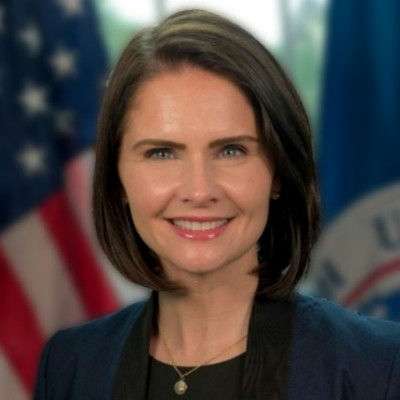
Kristen Edwards Marquardt joined Hakluyt & Co. in 2022 to build the company’s digital and cyber practice in North America. Prior to Hakluyt, she was chief cyber strategist and senior vice president for strategic planning, metrics, and reporting at Bank of America. In that role, Kristen was also responsible for reporting to the board of directors on all cyber security matters.
Prior to joining Bank of America, Kristen was the senior intelligence advisor to the Secretary of Homeland Security (DHS) with responsibility for intelligence, threat prevention, and counterterrorism. She advised the Secretary and Deputy Secretary on all intelligence and national security issues and often represented the department at the White House and with foreign partners on a range of department priorities.
Before serving at DHS, Kristen was a senior professional staffer on the House Foreign Affairs Committee covering the Middle East and counterterrorism policy. She began her career as an operations officer at the Central Intelligence Agency (CIA) and served with distinction in Afghanistan and other postings.
Kristen Edwards Marquardt joined Hakluyt & Co. in 2022 to build the company’s digital and cyber practice in North America. Prior to Hakluyt, she was chief cyber strategist and senior vice president for strategic planning, metrics, and reporting at Bank of America. In that role, Kristen was also responsible for reporting to the board of directors on all cyber security matters.
Prior to joining Bank of America, Kristen was the senior intelligence advisor to the Secretary of Homeland Security (DHS) with responsibility for intelligence, threat prevention, and counterterrorism. She advised the Secretary and Deputy Secretary on all intelligence and national security issues and often represented the department at the White House and with foreign partners on a range of department priorities.
Before serving at DHS, Kristen was a senior professional staffer on the House Foreign Affairs Committee covering the Middle East and counterterrorism policy. She began her career as an operations officer at the Central Intelligence Agency (CIA) and served with distinction in Afghanistan and other postings.
Kristen received a BA in International Relations and National Security Studies from Brigham Young University (BYU) and an MA in Political Science from the University of Utah.
Deborah Rosenblum has spent over 35 years working in the national security and defense field. Most recently, she served, from 2021 to 2025, as the Senate confirmed Assistant Secretary of Defense for Nuclear, Chemical and Biological Defense Programs as well as the Acting Deputy Under Secretary of Defense for Acquisition and Sustainment. In these roles she was responsible for all matters pertaining to acquisition; contract administration; logistics and materiel readiness; installations and environment; operational energy; chemical, biological and nuclear defense; as well as the defense industrial base.
From 2009 through 2021, she served as Executive Vice President at The Nuclear Threat Initiative, a global nonprofit focused on reducing catastrophic risks. She also advised corporate clients as a Vice President at The Cohen Group, a global consulting firm, on business opportunities in the defense and homeland security markets. Deborah is currently serving as a Senior Consultant to a range of defense companies; non-profits as well as academia.
She was educated at Middlebury College as well as Columbia University.
Alice Albright is a global executive with more than two decades of leadership across international development, global health, education, and innovative finance. Her career has focused on building institutions, pioneering new approaches to development finance, and advancing equitable growth and opportunity around the world. As Founder and Principal of Acadia Advisory, she advises philanthropic and development organizations as they navigate a shifting global landscape. Her work centers on supporting institutions as they consider how development models and financing approaches may need to evolve in the years ahead.
Albright served most recently as Chief Executive Officer of the Millennium Challenge Corporation (MCC) and the Global Partnership for Education (GPE). At MCC, she led a strategic refresh and helped secure the passage of bipartisan legislation expanding the agency’s country eligibility, adding 33 countries to its potential footprint. At GPE, she guided the organization’s evolution into a major multilateral funder and expanded its financing toolkit, including the launch of the Knowledge and Innovation Exchange (KIX), the GPE Multiplier, and a $500 million COVID-19 emergency window to sustain learning during school closures.
Previously, Albright helped establish the field of innovative development finance beginning at GAVI, where she co-designed and launched the International Finance Facility for Immunization (IFFIm) and the Advance Market Commitment (AMC) — mechanisms that transformed global vaccine access and mobilized more than $10 billion. She continued advancing new financing approaches at the Export-Import Bank of the United States, where she helped launch its first direct lending program for small businesses. Her work has taken her to more than 60 countries, engaging leaders at all levels to align diplomacy, finance, and policy in support of inclusive and sustainable growth.
Albright serves on the Board of the National Democratic Institute, is a Member of the Council on Foreign Relations, and sits on the Food Security Leadership Council. She is a graduate of Williams College and Columbia University’s School of International and Public Affairs.
Jennifer Short is a senior national security leader with more than 30 years of experience shaping strategy and leading operations at the highest levels of U.S. defense and government. She most recently served as Senior Military Assistant to the Secretary of Defense under two presidential administrations, advising on global defense strategy and operations across Europe, the Middle East, Asia, and U.S. homeland defense.
Throughout her career, Jennifer has led complex, multi-agency collaboration across the Department of Defense, Air Force, Space Force, and Congress, securing critical legislative outcomes and funding for defense modernization, cyber strategy, and space capabilities. A combat-proven A-10 fighter pilot and former Commander of the 23rd Wing, she led more than 6,000 personnel and global combat search and rescue operations.
Jennifer holds degrees from Arizona State University, Touro University International, and the National War College, and is an International Women’s Forum Leadership Fellow with executive education from INSEAD and Harvard Business School.
Paloma Adams-Allen is President and Chief Executive Officer of Airlink, a nonprofit organization that harnesses the power of aviation to provide humanitarian relief to communities in crisis. Prior to Airlink, she served in the Biden Administration as the United States Agency for International Development’s Chief Operating Officer and Deputy Administrator for Management and Resources. As second in command, she oversaw operations in over a 100 countries and led an ambitious internal reform agenda that modernized private sector engagement, spurred locally-led development, and slashed bureaucratic burdens on staff and partners.
Adams-Allen was the President and CEO of the Inter-American Foundation from 2017-2021, a period of transformation for the foundation marked by significant growth in its revenues, geographic reach, and partnerships. She has also served in senior roles at Winrock International and USAID’s Latin America and Caribbean Bureau, where she launched new public private partnerships outfits to mobilize funding and know-how and scale development impact. Adams-Allen, who speaks Spanish, also worked at the Organization of American States in programming and leadership roles for over a decade. She is currently the President of Brown University’s Women’s Alumni Network, and serves on the boards of the global non profit, Pact, and the French social impact organization, Livelihoods Venture.
Ms. Adams-Allen spent her childhood between rural Jamaica and the New England region of the U.S. She earned a Juris Doctorate from Georgetown University Law Center, a Bachelor of Arts in Development Studies from Brown University, and a Masters in International Affairs from Johns Hopkins University’s School of Advanced International Studies. An avid hiker and gardener, she lives in Washington, D.C. with her husband, two awesome daughters, and an energetic puppy.
Caroline Zier has over 15 years of experience in defense and national security, and is currently the Deputy Lead for National Security Policy at OpenAI. She previously served as the Deputy Chief of Staff to the Secretary of Defense, where she was responsible for helping manage the Secretary of Defense’s executive staff and providing counsel and advice to the Secretary on all matters concerning the Department.
From 2021 to 2023, Caroline was the Senior Advisor and Special Assistant to the Secretary of Defense with responsibility for policy and national security matters. From 2018 to 2021, Caroline was the Director for Global Posture within the Office of the Secretary of Defense for Policy, leading a team responsible for providing oversight and management of the forces, footprint, and agreements that support the Department’s global operations and activities.
From 2016 to 2018, Caroline served as the Chief of Staff to the Assistant Secretary of Defense for Indo-Pacific Security Affairs. She joined the Office of the Secretary of Defense for Policy in 2009, and held several other positions in the organization. Prior to her government service, Caroline worked at Morgan Stanley in New York as an analyst. She graduated from Yale University with a Bachelor of Arts and received a Master of Science in Foreign Service from Georgetown University. She is the recipient of the Distinguished Public Service Award and the Meritorious Civilian Service Award. She is a nonresident senior fellow at the Atlantic Council’s Scowcroft Center for Strategy and Security.
Shelby Pierson advises a broad range of defense-tech, AI, and national-security companies across venture-backed, early-stage, and growth ecosystems, with a tireless focus on integration and operational outcomes. She partners with CEOs, founders, and investors to scale technology for government adoption, accelerate product-market fit inside the national security enterprise, and shape mission-aligned strategies for data, AI/ML, advanced sensing, and geospatial innovation.
Shelby also serves on corporate boards, bringing expertise in enterprise risk, oversight, modernization, and international partnership management. Her portfolio work focuses on building tech-forward operating rhythms, aligning investments to measurable mission value, and strengthening governance to deliver durable performance. Shelby has more than 25 years of national security leadership experience in the U.S. intelligence community, known for translating strategy into execution across large, matrixed organizations.
Ambassador Nina Hachigian (ret) was the first U.S. Special Representative for City and State Diplomacy at the U.S. Department of State from 2022 to 2025 in the Biden Administration. Before that, Amb, Hachigian served as the first Deputy Mayor for International Affairs for the City of Los Angeles for five years. From 2014 to 2017, Ambassador Hachigian served as the second U.S. Ambassador to the Association of Southeast Asian Nations (ASEAN) in the Obama Administration. Earlier, she was a Senior Fellow and a Senior Vice President at the Center for American Progress focused on Asia policy and U.S.-China relations. Before that, Ambassador Hachigian was the director of the RAND Center for Asia Pacific Policy for four years.
Ambassador Hachigian served on the staff of the National Security Council in the Clinton White House from 1998-1999. She is the editor of Debating China: The U.S. – China Relationship in Ten Conversations (Oxford University Press, 2014) and co-author of The Next American Century: How the U.S. Can Thrive as Other Powers Rise (Simon & Schuster, 2008). She went to Yale University and got her JD from Stanford University.
Deborah Lee James has 35 years of senior leadership experience in the aerospace, defense and technology fields in both the public and private sectors. Most notably, she served as the 23rd Secretary of the Air Force and Principal Defense Space Advisor (2013-2017) and as the President of SAIC’s Technical and Engineering Sector, a $2 billion, 8,700-person enterprise (2012-2013). Earlier in her career, she was Assistant Secretary of Defense (Reserve Affairs) and a Professional Staff Member for the House Armed Services Committee.
Since 2017, Ms. James has served as an independent director of three public company boards: Textron, Unisys and Aerojet Rocketdyne, as well as a director on several private and not for profit boards. She is a strategic advisor on topics including mergers and acquisitions, government contracting, technology transformation, and space. She is the author of the book “Aim High: Chart Your Course and Find Success”, a speaker on leadership and national security topics and a mentor to C-suite level executives in Fortune 500 firms.
Senate Confirmed in August 2017, the Honorable Ellen M. Lord formerly served as the Under Secretary of Defense for Acquisition and Sustainment (A&S). In this capacity, she was responsible to the Secretary of Defense for all matters pertaining to acquisition; developmental testing; contract administration; logistics and materiel readiness; installations and environment; operational energy; chemical, biological, and nuclear weapons; the acquisition workforce; and the defense industrial base.
Prior to this appointment, from October 2012 – June 2017, Ms. Lord served as the President and Chief Executive Officer of Textron Systems Corporation, a subsidiary of Textron Inc. In this role, she led a multi-billion dollar business with a broad range of products and services supporting defense, homeland security, aerospace, infrastructure protection, and customers around the world.
Ms. Lord has more than 30 years of experience in the defense industry, serving in a variety of capacities, to include Senior Vice President and General Manager of Textron Defense Systems, now Weapon & Sensor Systems; and Senior Vice President and General Manager of AAI Corporation, now known as Textron Systems’ Electronic Systems, Support Solutions, and Unmanned Systems businesses. Earlier in her career, Ms. Lord served as Vice President of Integration Management for Textron Systems and Vice President of Intelligent Battlefield Systems for Textron Defense Systems, in addition to other business and operations positions.
Soladé Rowe is Partner at the leading talent advisory firm, DHR Global where he advises government and nonprofit clients on executive recruitment, performance management, and leadership coaching. Prior to executive search, Soladé held several HR management roles within the retail, life sciences, management consulting, and investment banking industries. In his last corporate position, he held talent acquisition and performance management responsibilities, where he played a vital role in the company’s merger integration and supported the expansion of its e-commerce business. Soladé started his career in higher education and has served as a Trustee for his alma mater for over 20 years and serves as Chair of the Compensation Committee.
A first-generation American from Sierra Leone, Soladé holds a Bachelor of Science in International Business from Utica University and a Master of Science in Organizational Change Management from The New School for Social Research in New York City. He is also certified in Hogan Leadership Assessments. A native New Yorker, Soladé resides in Washington, D.C. with his wife and two sons.
Emily Perkins is a senior leader of policy-focused non-profit organizations. Her 20-year career spans international program management, fundraising, and external relations.
Perkins served most recently as Vice President of Development at the Joint Center for Political and Economic Studies where she helped “America’s Black think tank” create a multi-year development strategy and establish operational best practices across the organization. She previously spent eight years at the Brookings Institution where she led fundraising strategy and operations for teams whose issues ranged from foreign policy to domestic political institutions. She has also held program management and business development roles in the private sector.
Perkins earned a B.A. in Political Science from Boston College and an LL.M. from the University of Kent’s Brussels School of International Studies.
Nisha Biswal brings over 30 years of experience in U.S. foreign policy and international economic development including in the Executive Branch, in Congress and the private sector. Most recently, she served as Deputy CEO of the U.S. International Development Finance Corporation (DFC), overseeing operations, management and policy coordination, and helping DFC become the largest bilateral development finance institution in the world. Biswal was senior vice president for international strategy and global initiatives at the U.S. Chamber of Commerce from 2017-2023 and led the South Asia practice.
Her prior government service includes Assistant Secretary for South and Central Asian Affairs at the U.S. Department of State from 2013 to 2017. There she oversaw the U.S.-India strategic partnership, including the launch of an annual U.S.-India Strategic and Commercial Dialogue. She also initiated the C5+1 Dialogue with Central Asia and the US-Bangladesh Partnership Dialogue during her tenure as Assistant Secretary. Prior to that, Biswal was assistant administrator for Asia at the U.S. Agency for International Development (USAID),having previously worked in the Office of Foreign Disaster Assistance and the Bureau for Humanitarian Response. She also spent over a decade on Capitol Hill, working as staff director on the State and Foreign Operations Subcommittee on Appropriations as well as professional staff on the Foreign Affairs Committee in the House of Representatives.
Heidi is a General Partner and Executive Vice President at America’s Frontier Fund, a venture capital fund that invests in frontier technologies vital to the long-term competitiveness and national security of the United States and close allies. She is also an Adjunct Senior Fellow at the Council on Foreign Relations where she specializes in Economic Statecraft and leads the high-level Roundtable Series on Geoeconomics. She is the former CEO, and remains a Partner, at International Capital Strategies – a boutique advisory firm that provides clients with market-relevant insights on the intersection of macroeconomics, geopolitics, policy and global financial markets.
She served on the Biden Treasury Department Transition team as lead on International Affairs through January 2021. From August 2019 through the 2020 election, she led and built Biden’s international economic policy team for his Presidential campaign, crafting and contributing to incoming Administration policy on national economic security, China policy, supply chain resilience, trade, energy and energy security, the IMF and Multilateral Development Banks, sanctions and export controls, as well as to the domestic competitiveness and investment agenda.
Linda Robinson is Senior Fellow for Women and Foreign Policy at the Council on Foreign Relations, where she is currently writing a book about women political leaders and leadership archetypes. Robinson is a national security and foreign affairs expert, best-selling author, and prize-winning former foreign correspondent. She has testified before Congress multiple times on national security, the Middle East, and military issues. She is the author of three critically acclaimed and best-selling books about Afghanistan, Iraq and the special forces, One Hundred Victories (2013), Tell Me How This Ends (2008), and Masters of Chaos (2004).
She has served as chair of the Army War College Board of Visitors, for which she received the Army’s Outstanding Civilian Service Award, and as a member of the National Defense University board. She has also served as a senior adviser to the U.S. State Department, U.S. Central Command, and other military headquarters commands. As a volunteer advisor on the Biden presidential campaign, Robinson led the Special Operations / Low Intensity Conflict team of the Defense Working Group.
Before joining the Council on Foreign Relations, Robinson was a senior policy researcher and director of its Center for Middle East Public Policy at the RAND Corporation.
Jeannette Gaudry Haynie, PhD, is a security and conflict scholar, retired Marine Corps officer and combat veteran, and former government senior executive leader. A New Orleans native and U.S. Naval Academy graduate, she is a Cobra attack helicopter pilot by trade who has served both within and outside the government in a wide range of leadership roles. Within the government, she has served on active duty, as a reservist, and in a civilian executive leadership role at the Department of Defense; outside of government, she has served as a principal research scientist, nonprofit executive, and adjunct professor.
Dr. Haynie served on active duty as a Cobra pilot and instructor before transitioning into the reserves and beginning graduate school. While serving on the Joint Staff and in the Marine Corps Commandant’s think tank, she earned her MA in Political Science from the University of New Orleans and her PhD in International Relations from The George Washington University. She retired after 22 years of combined active and reserve service in the Marine corps.
Deborah Curtis, former CIA Deputy General Counsel for Litigation and Investigations, is a partner in Arnold & Porter’s White Collar Defense and Investigations practice. Her experience spans a wide range of senior level positions in the federal government involving sensitive intelligence, law enforcement and policy issues.
At CIA, Deborah oversaw the Agency’s response to litigation, congressional investigations, critical incidents and criminal matters. In this role, Deborah advised the CIA’s Director and Deputy Director, the Office of Congressional Affairs, the Counterintelligence Mission Center and the Office of Security. She also handled several major national security policy initiatives including representing CIA interests during the U.S.-EU negotiations to reach a transatlantic data privacy agreement and the provision of U.S. information in support of Russian war crimes prosecutions before the International Criminal Court.
Prior to joining CIA, Deborah was the Chief Counsel for Industry and Security at the Commerce Department, the senior-most legal official on all licensing and enforcement decisions involving the Entity List, Military End-User List, Denied Persons List, Unverified List and other issues arising under the Export Administration Regulations. During her time at Commerce, Deborah also co-drafted the Huawei Foreign Direct Product Rule and advised on the CFIUS-adjacent process prohibiting certain foreign transactions that could impact the U.S. Information and Communications Technology and Services supply chain.
Deborah previously served for more than a decade at the Department of Justice, including at the National Security Division’s Counterespionage Section. At Main Justice, she oversaw Espionage Act cases and criminal export control and sanctions investigations and prosecutions nationwide. Deborah was also a Deputy Chief for National Security at the U.S. Attorney’s Office for the District of Columbia, where she investigated, prosecuted and supervised cases involving espionage, illegal foreign agents, state-sponsored malicious cyber intrusions and matters involving the ITAR, FCPA and theft of trade secrets.
Finally, as an Associate General Counsel for National Security and Military Affairs at the Pentagon, Deborah provided legal guidance on Air Force Special Access Programs involving air and space system projects, the issuance of national interest determinations, commercial facilities physical security breaches and counterintelligence “insider threat” probes.
Leah Nodvin is the Director of Government and External Affairs at the BMW Group, where she supports U.S. – European relations and covers the federal sustainability portfolio. Previously, Leah served as the Chief of Staff for the Bureau of Europe and Eurasia at USAID. Prior to joining USAID, she worked on Capitol Hill and most recently served as the Staff Director for the House Foreign Affairs Subcommittee for Europe, working on behalf of Congressman Bill Keating of Massachusetts. During her time on Capitol Hill, Leah also served as a Professional Staff Member on the House Foreign Affairs Subcommittee for Europe as well as a Foreign Affairs Legislative Assistant for a Senior Member of the House Foreign Affairs Committee.
Prior to her time in Washington, Leah completed a research Fellowship with the Parliamentary Assembly of the Organization for Security and Cooperation in Europe in Vienna, Austria. Leah holds a bachelor’s degree from Boston University as well as master’s degrees from the University College’s London School of Slavonic and East European Studies and the Higher School of Economics in Moscow. Leah is currently completing a master’s degree in Defense and Strategic Studies at the Naval War College. Leah grew up in New Hampshire and speaks basic French, intermediate Russian, fluent German and is a native English speaker.
Brandi Vann, PhD, is a globally experienced national security executive, currently serving as Director for Strategy at Draper and a member of the Board of Directors of 908 Devices. In these roles, she helps organizations strengthen their business and technical strategies and engage effectively with national security communities worldwide.
In July 2025, Dr. Vann concluded a distinguished career in the U.S. Department of Defense (DoD), where she most recently served as the Acting Assistant Secretary of Defense for Nuclear, Chemical, and Biological Defense Programs (ASD(NCB)) and as the Principal Deputy Assistant Secretary of Defense for Nuclear, Chemical, and Biological Defense Programs. In this capacity, she advised the senior Defense Department leadership on management and execution of programs related to nuclear weapons, biological and chemical defense programs, chemical demilitarization, countering weapons of mass destruction, and treaty management. She also served as Staff Director of the Nuclear Weapons Council, leading efforts to assess and maintain the U.S. nuclear weapons stockpile, ensure sustainment and operations of deployed systems, and plan for modernization. Across her DoD tenure, Dr. Vann contributed to every phase of capability development, including policy, strategy, research and development, acquisition, and operations. Before serving as the Principal Deputy Assistant Secretary of Defense for Nuclear, Chemical, and Biological Defense Programs she was the Deputy Assistant Secretary of Defense for Chemical and Biological Defense. She oversaw a multibillion-dollar portfolio spanning chemical and biological defense, counterproliferation, countering weapons of mass destruction, nuclear forensics, international cooperation, and business operations. Notably, she co-led the first-ever Biodefense Posture Review (BPR), which fundamentally reformed DoD policy, strategy, and execution of global biodefense operations. In 2023, President Biden awarded Dr. Vann the Meritorious Presidential Rank Award for her transformative contributions to biodefense and her support of critical DoD initiatives.
Before joining the Department of Defense, Dr. Vann served as Director of Laboratories at Nephron Pharmaceuticals Corporation and was a visiting scientist at the Federal Bureau of Investigation. Dr. Vann holds a PhD in Chemistry from the University of South Carolina, where she specialized in analytical chemistry and applied statistics.
Dr. Jung H. Pak was Deputy Assistant Secretary in the Bureau of East Asian and Pacific Affairs at the U.S. Department of State. During her tenure at State, she was responsible for overseeing relations with Australia, New Zealand, and the Pacific Islands (2023-2024); deepening and expanding U.S. relationship with the Association of Southeast Asian Nations and related fora (2021-2023); and leading on Global China issues (2021-2022), developing new initiatives and strengthening collaboration with key foreign interlocutors. She concurrently served as U.S. Deputy Special Representative for North Korea from 2021-2023 and as the top U.S. official on North Korea policy from 2023-2024.
Prior to arriving at State, Dr. Pak was a senior fellow at the Brookings Institution, where she focused on Korean Peninsula issues, East Asia regional dynamics, and transnational threats related to proliferation, cybersecurity, and climate change. While at Brookings, she authored Becoming Kim Jong Un, which has been translated into multiple languages and draws from her deep knowledge and experience as an intelligence officer.
Dr. Liz Sherwood-Randall is currently a Senior Fellow at the Harvard Kennedy School Belfer Center for Science and International Affairs. She has had a trailblazing career in national and homeland security, serving in key leadership roles at the White House, the Department of Energy, and the Department of Defense. Most recently, Liz worked in the West Wing from 2021-2025 as the Assistant to the President for Homeland Security and Deputy National Security Advisor. In that high stakes position, she pioneered Federal efforts to strengthen national preparedness for and resilience to emerging threats. She spearheaded Federal crisis management for a wide range of challenges including mass shootings, domestic and international terrorist attacks, extreme weather events, and critical infrastructure disruptions. She guided the development and implementation of new strategies to counter terrorism at home and around the world. She innovated policies to prevent, prepare, and respond to natural and pernicious biological risks, including mpox, avian flu, and the convergence of advances in biotechnology and artificial intelligence. She built a counter-fentanyl campaign involving Mexico, Canada, and China, and mobilized a global coalition of more than 80 partner countries to disrupt the synthetic opioid supply chain and save American lives.
During the Obama Administration, Liz served in three successive roles: Deputy Secretary of Energy (2014-2017); White House Coordinator for Defense Policy, Countering Weapons of Mass Destruction and Arms Control (2013-2014); and Senior Director for Europe on the National Security Council (2009-2013). She served in the Clinton Administration as Deputy Assistant Secretary of Defense for Russia, Ukraine, and Eurasia (1994-1996). At the beginning of her career, she served as Chief Foreign Affairs and Defense Policy Advisor to Senator Joe Biden. She has been repeatedly recognized for her leadership, including with the Secretary of Energy Exceptional Service Award, the Department of Defense Nunn-Lugar Trailblazer Award, and the Department of Defense Medal for Distinguished Public Service.
Liz has taught, conducted research, and mentored students at universities and think tanks including Harvard, Stanford, the Georgia Institute of Technology, and the Council on Foreign Relations. She has also advised national laboratories, power grid and cybersecurity startups, and energy investment funds.
Born and raised in Los Angeles, Liz graduated from Harvard College and received her doctorate in international relations as a Rhodes Scholar at Balliol College of Oxford University. She is married to Dr. Jeffrey Randall, a neurosurgeon in the California Bay Area, and they have two sons.
Anne Witkowsky previously served as Assistant Secretary of State for Conflict and Stabilization Operations.
Previously, Witkowsky served as the Co-Director of the Task Force on U.S. Strategy to Support Democracy and Counter Authoritarianism, a partnership of Freedom House. From 2014-2016, she served as the Deputy Assistant Secretary of Defense for Stability and Humanitarian Affairs in the Office of the Secretary of Defense (OSD), U.S. Department of Defense (DoD). She held policy responsibility for peacekeeping and stability operations; humanitarian assistance and disaster response; DoD support to the security of U.S. embassies; and international humanitarian law, rule of law and protection of human rights. Her office coordinated the DoD policy role in key Administration initiatives, such as the U.S. Ebola response, strengthening United Nations peace operations, and support to embassy security.
From 2009-2013, she served as the Deputy Coordinator for Homeland Security and Multilateral Affairs (DAS equivalent) in the Bureau of Counterterrorism (CT), U.S. Department of State, with responsibility for terrorist designations and sanctions; strengthening international transportation security; developing bilateral information sharing agreements; and building CT cooperation within multilateral organizations. In 2012-2013, she also served as the CT Bureau’s Acting Principal Deputy Coordinator.
Suzanne Spaulding is senior adviser for homeland security and director of the Defending Democratic Institutions project at the Center for Strategic and International Studies (CSIS). She also serves as a member of the Cyberspace Solarium Commission. Previously, she served as Undersecretary for the Department of Homeland Security (DHS), where she led the National Protection and Programs Directorate, now called the Cybersecurity and Infrastructure Security Agency (CISA), managing a $3 billion budget and a workforce of 18,000, charged with strengthening cybersecurity and protecting the nation’s critical infrastructure, including election infrastructure. She led the transformation of budget, acquisition, analytic, and operational processes to bring greater agility and unity of effort to an organization that had experienced dramatic growth through acquisition of new entities and missions over several years. Throughout her career, Ms. Spaulding has advised CEOs, boards, and government policymakers on how to manage complex security risks across all industry sectors. At DHS, she led the development and implementation of national policies for strengthening the security and resilience of critical infrastructure against cyber and physical risks, including the National Infrastructure Protection Plan and key presidential directives and executive orders.
Stephanie Barna is Of Counsel in the Public Policy Practice Group of Covington & Burling LLP. She draws on more than three decades of U.S. military and government service to provide advisory and advocacy support and counseling to clients facing policy and political challenges in the aerospace and defense sectors.
Prior to joining the firm, Stephanie served as General Counsel of the Senate Armed Services Committee. A member of the Committee’s senior leadership team, she was responsible for shepherding the annual National Defense Authorization Act through the Committee and on the Senate floor. She oversaw the Senate confirmation process for military general and flag officers and for civilian nominees for Presidential appointment to positions in the Department of Defense and the Department of Energy nuclear enterprise. She also managed an expansive portfolio encompassing the use of military force and war powers, the organization and structure of the Department of Defense, and the uniform code of military justice. She was the Committee lead for investigations.
AT Johnston currently serves as a Professional Staff Member on the House Armed Services Committee.
AT Johnston is an experienced senior government official with twenty-five plus years of service. She is an inclusive, mission-driven leader who demonstrates a heart for supporting people and organizations in service to others. She is passionate about growing the next generation of leaders.
As a senior leader at the Pentagon, AT served as the Acting Assistant Secretary of Defense for Legislative Affairs (OSDLA) where she advised the Secretary and Deputy Secretary of Defense on legislative strategy and developed and executed the congressional engagement strategy. She managed the DOD legislative interface as part of the whole of government response to the COVID 19 pandemic, during a time of civil unrest and transition.
Christine Abizaid led the United States Government’s counterterrorism enterprise while serving as the Director of the National Counterterrorism Center (NCTC) from June 2021 to July 2024. She was the eighth Senate confirmed Director and the first woman to lead NCTC, the primary U.S. intelligence organization that integrates, analyzes, and shares terrorism information.
Before joining NCTC, Abizaid was as an executive at Dell Technologies in its Global Operations organization, where she led and advised on geopolitical and strategic risk analysis; supply chain security; sustainability and transparency initiatives; compliance; and global inventory management. While in the private sector, Abizaid was aboard member for the Responsible Business Alliance; a board member at the Middle East Policy Council; and an inaugural Steering Committee Member for the Leadership Council for Women in National Security (LCWINS).
Colonel (retired) Patricia Mulcahy is an accomplished human resources leader and senior executive with a career that spans over 40 years as an Army officer and a civil servant. In her culminating assignment with the Department of the Air Force, Pat was the first Chief Human Capital Officer of the newest military service – the U.S. Space Force. She was responsible for creating the Space Force’s first comprehensive human capital strategy, including establishing core values, talent management goals, uniform design, motto, and logo, and conducting the most extensive transfer plan for military members since the Air Force was established in 1947.
Pat was commissioned into the Army from the Siena College Reserve Officer Training Corps program. She served at every level in the field of military personnel management and personnel service support including command of a company at Fort Devens and in Germany; a battalion at Fort Stewart; and a brigade in 18th Airborne Corps that deployed to Iraq, as well as key staff assignments as the G-1, 3rd Infantry Division; XO, Army G-1; and J-1, European Command. Following her retirement from the Army in 2009, Pat served as a federal civilian employee as well as a member of the Senior Executive Service in several military personnel policy positions in the Office of the Under Secretary of Defense for Personnel and Readiness including the Director of Officer and Enlisted Personnel Management. Pat also served as the Deputy Assistant Secretary of the Air Force for Force Management Integration.
Laura McAleer is the University of Notre Dame’s Associate Vice President for Federal and Washington Relations, responsible for the development and execution of the University’s strategic priorities in the Nation’s capital.
Prior to joining Notre Dame, McAleer served for more than twenty years as a defense and foreign policy advisor and analyst, most recently at the Department of Defense as the Deputy Assistant Secretary of Defense for Senate Affairs and acting Principal Deputy Assistant Secretary of Defense for Legislative Affairs. Previously, she worked on Capitol Hill for more than a decade, serving as a national security and foreign policy advisor to four U.S. Senators and on the Majority Staff of the Senate Foreign Relations Committee.
In addition to her congressional experience, McAleer’s public service includes assignments as a strategy and plans officer for U.S. Special Operations Command Africa, as an analyst and program manager with the Office of Naval Intelligence, and as the Director for Strategic Initiatives for the Secretary of the Navy. She also served for more than a decade as an intelligence officer in the U.S. Navy Reserve.
Dr. Rebecca Bill Chavez is president and CEO of the Inter-American Dialogue. She is formerly a senior fellow in the Dialogue’s Rule of Law Program. She is a member of the Truman Center for National Policy Board of Directors, the Leadership Council for Women in National Security (LCWINS) Steering Committee, the Princeton University Institute for Regional and International Studies Advisory Board, and the Foreign Policy for America Advisory Board.
Dr. Chavez served as Deputy Assistant Secretary of Defense for Western Hemisphere Affairs from 2013 until 2016 where she prioritized Women, Peace, and Security initiatives, combatting the militarization of law enforcement, and expanding defense institution building programs. Her areas of focus included shaping Defense Department contributions to President Obama’s Central America Strategy, moving the U.S.- Mexico relationship beyond the narrow counternarcotics focus, supporting the Colombian peace process, resetting defense relations with Argentina and Brazil, and establishing a productive dialogue with Cuba on humanitarian assistance and disaster response.
Sherri Goodman serves as Vice-Chair of the US Secretary of State’s International Security Advisory Board (ISAB). She is also the Secretary General of the International Military Council on Climate & Security (IMCCS), representing over 40 military and national security organizations addressing the security risks of a changing climate. She is credited with educating a generation of U.S. military and government officials about the nexus between climate change and national security, using her famous coinage, “threat multiplier,” to fundamentally reshape the national discourse on the topic.
She is a Senior Fellow at the Woodrow Wilson International Center’s Polar Institute and Environmental Change & Security Program, as well as a Senior Strategist at the Center for Climate & Security.
Sherri chairs the Board of the Council on Strategic Risks and chairs the External Advisory Board on Energy and Homeland Security for Sandia National Laboratories. She is the Vice-Chair of the Board of the University Corporation for Atmospheric Research (UCAR).
Allison Peters previously served as the Deputy Assistant Secretary of State in the Bureau of Democracy, Human Rights, and Labor at the U.S. Department of State where she oversaw the Bureau’s Office of Multilateral and Global Affairs, including its work on technology and human rights, Office of East Asian and Pacific Affairs, and Office of Policy Planning and Public Diplomacy. Previously, Ms. Peters served as the Senior Advisor to the Under Secretary for Civilian Security, Democracy, and Human Rights and the Senior Advisor to the Assistant Secretary for International Narcotics and Law Enforcement Affairs where she worked to advance rights-respecting approaches to technology and cyber policy and counter threats.
Prior to her time in government, Peters served as the Deputy Director of the National Security Program at the think tank Third Way where she regularly advised policymakers on a broad spectrum of foreign policy and national security issues. In this capacity, she helped to lead the Program’s Cyber Enforcement Initiative where her writing, research, and policy development focused on strengthening global cooperation and capacity to identify and bring to justice malicious cyber actors.
Janine Davidson, Ph.D., has served as president of Metropolitan State University of Denver since 2017. She is a national thought leader in higher education and on topics such as public service, U.S. foreign policy and national security.
Prior to her time at MSU Denver, Davidson served as the 32nd under secretary of the United States Navy. Her appointment by then-President Barack Obama as Navy “under” followed nearly 30 years of academic, civilian and military service.
She has taught at George Mason University, Georgetown University, Davidson College and various professional military schools, and was an aviation and aerobatics flight instructor at the U.S. Air Force Academy. She recently returned to the classroom at MSU Denver, co-teaching a course on the philosophical and legal origins of freedom of speech in the United States.
Davidson began her career as an Air Force officer and cargo pilot. She was a distinguished graduate of the Air Force Squadron Officer School and was the first woman to fly the Air Force’s tactical C-130. Her various honors include: HillVets Top 100 Most Influential Veterans; University of South Carolina Distinguished Alumna; Secretary of the Navy Medal for Distinguished Public Service; Secretary of Defense Medal for Outstanding Public Service; Girl Scouts of Colorado 2018 Woman of Distinction; the Colorado Women’s Chamber of Commerce 2019 Top 25 Most Powerful Women in Business; a 2021 Denver Business Journal Most Admired CEO; and a 2022 9NEWS Leader of the Year finalist.
Ambassador (ret.) Greta C. Holtz is the President and CEO of Amideast, a leading non-profit organization which works to provide live-changing educational and exchange programs in the Middle East and North Africa and for U.S. students and faculty. Ambassador Holtz served as a career diplomat with extensive experience in the Middle East and North Africa. She was the U.S. Ambassador to Oman from 2012 to 2015, the Chargé d’affaires in Qatar from 2020-2021, and the Minister-Counselor for Provincial Affairs at the U.S. Embassy in Baghdad from 2009 to 2010. Additional overseas postings included Saudi Arabia, Yemen, Tunisia, Syria, and Turkey, and her domestic assignments included serving as the Deputy Assistant Secretary of State for Public Diplomacy and Strategic Communication in the Bureau of Near Eastern Affairs, and the Principal Deputy Assistant Secretary of State for South and Central Asia.
Ambassador Holtz’s broad experience encompasses a number of other positions, including as Chancellor and Vice Chancellor of the College of International Security Affairs at the National Defense University, and Senior U.S. Coordinator for Operations Allies Refuge (OAR) in Doha, Qatar. Ambassador Holtz also served as the State Department’s Coordinator for the Organization for Security and Cooperation in Europe (OSCE), a Senior Watch Officer in the State Department’s Executive Secretariat’s Operations Center, a 24/7 crisis management and communications center, and the Senior Foreign Policy Advisor to the Commanding General of the U.S. Special Operations Command, providing strategic guidance for special operations missions worldwide.
Ambassador Holtz holds a BS in Political Science from Vanderbilt University, an MS in International Relations from the University of Kentucky’s Patterson School of Diplomacy and International Commerce, and an MS in National Security Studies from the National War College. She speaks French, Arabic, and Turkish, and is the recipient of numerous State Department awards, as well as awards from the Department of Defense and Central Intelligence Agency. She is a member of the American Academy of Diplomacy, a member of the Board of Advisors for Spirit of America, and a member of the Board of Directors for The Marshall Legacy Institute. Ambassador Holtz is a non-resident Distinguished Fellow at the University of South Florida’s Global and National Security Institute and is a distinguished graduate of University of Kentucky’s Patterson School of International relations and Commerce.
Bonny Lin is a senior fellow for Asian security and director of the China Power Project at the Center for Strategic and International Studies (CSIS). Previously, she was the acting associate director of the Strategy and Doctrine Program of RAND Project AIR FORCE and a political scientist at the RAND Corporation, where she analyzed different aspects of U.S. competition with China, including U.S.-China competition for influence in the Indo-Pacific and China’s use of gray zone tactics against U.S. allies and partners.
Her research advised senior leaders in the Department of Defense, including military leaders at U.S. Pacific Air Forces and U.S. Army Pacific. Dr. Lin also served in the Office of the Secretary of Defense from 2015 to 2018, where she was director for Taiwan, country director for China, and senior adviser for China. Dr. Lin holds a PhD in political science from Yale University, a master’s degree in Asian studies with a focus on China from the University of Michigan, and a bachelor’s degree in government from Harvard College.
Michelle J. Howard served 35 years in the United States Navy. She led Sailors and Marines multiple times in her career as the Commander of: a ship, an Expeditionary Strike Group, Task Force, and a Naval theater. Her last command was from 2016 to 2017 as U.S. Naval Forces Europe and U.S. Naval Forces Africa. She simultaneously led NATO’s Allied Joint Force Command Naples with oversight of missions from the Western Balkans to Iraq. Operations in her career include: NATO peacekeeping, West African Training Cruise, Indonesia Tsunami Relief operations, and the rescue of Maersk Alabama from Somali Pirates. Michelle J. Howard is a Desert Storm and Operation Iraqi Freedom veteran.
In 1999 Michelle J. Howard became the first African American woman to command a ship in the Navy. In 2014, she was the first woman to become a four-star Admiral in the U.S. Navy and the first woman to be appointed to the position of Vice Chief of Naval Operations (number two in a Military Service). She is the first African American woman to reach the rank of three-star and four-stars in the Armed Forces.
Dani Schulkin is Director of the Democracy Initiative at Just Security at NYU School of Law. Schulkin formerly served as Senior Counsel to the Deputy Attorney General and Senior Advisor to the Homeland Security Advisor at the White House. Her work spans national security, democratic governance, and administrative law.
Schulkin served as Senior Counsel to the Deputy Attorney General at the U.S. Department of Justice, where she coordinated national security policy and led on issues ranging from election security and foreign malign influence to international synthetic opioid trafficking. She was also Senior Advisor to the Homeland Security Advisor at the National Security Council (NSC), managing domestic crisis response, terrorism prevention, and other domestic security issues from the White House. She began her service in the Biden Administration with the Office of the Staff Secretary, working on the team charged with reviewing all presidential briefing memos and executive actions.
Schulkin has held roles at the Administrative Conference of the United States (ACUS), the New York Attorney General’s Bureau of Internet and Technology, and the U.S. Attorney’s Office for the Eastern District of New York. She began her legal career as a Legal Fellow at Just Security. Her writing has appeared in The New York Times, Slate, Yale Journal on Regulation, the University of Pennsylvania Regulatory Review, and Just Security, covering domestic terrorism, democratic governance, and national security. She holds a J.D. from NYU School of Law, where she received the Vanderbilt Medal and was Editor-in-Chief of the Journal of Legislation and Public Policy, and a B.A. from Harvard University, where she was Captain of the Harvard Women’s Swim and Dive Team.
A native of Cuba, former U.S. Rep. Ileana Ros-Lehtinen (R-FL) served for almost three decades as a Member of Congress representing diverse areas in South Florida. She was the Chairwoman of the House Committee on Foreign Affairs and the Chairwoman of the Subcommittee on the Middle East and North Africa (MENA). In these roles, she led on pressing foreign policy issues, including championing the advancement of freedom and democracy for all, fighting Islamist extremism; supporting free trade agreements with Colombia, Panama, and South Korea; and imposing sanctions on human rights violators in Venezuela. Her record over nearly four decades of public service includes fighting against tyranny and oppression, particularly in her native homeland of Cuba, as well as working diligently to support and strengthen the US – Israel strategic partnership.
Rep. Ros-Lehtinen served on the House Permanent Select Committee on Intelligence and was a member of the CIA Subcommittee and the National Security Agency and Cybersecurity Subcommittee. A strong proponent of education, Rep.
Johnnie Kaberle is a Senior Vice President at WestExec Advisors, where she helps clients navigate the intersection of Congress, the Department of Defense, and the intelligence community. Prior to joining WestExec, Johnnie spent over three decades on Capitol Hill, culminating as Staff Director of the House Defense Appropriations Subcommittee and Deputy Staff Director of the full Appropriations Committee. In that role, she led bipartisan negotiations and shaped hundreds of billions in national security funding—playing a central role in advancing innovation, acquisition reform, and capability delivery to the warfighter. Today, Johnnie draws on that deep institutional experience to help clients understand how decisions are made in Washington, identify and pursue strategic opportunities, and build lasting relationships with key stakeholders. She also teaches legislative negotiation and is known for her ability to help clients “decode” complex government processes and deliver impact where it matters most.
Caitlin Hayden is the London-based Group Communications Director for BAE Systems, one of the largest aerospace, defense, and security firms in the world, employing around 110,000 people with customers in more than 40 countries. In this role, Hayden leads global communications and serves as a member of the company’s executive committee.
Prior to this, she served as the Senior Vice President of Communications at BAE Systems, Inc., leading all external and internal communications for the U.S. business.
Before joining BAE Systems, Hayden had accumulated nearly two decades of communications and leadership experience. This includes serving as vice president of Communications for the Aerospace Industries Association (AIA), leading the organization’s work to tell the aerospace and defense industry’s story in the U.S. and around the world. Previously, Hayden was executive vice president and Media Group director in Edelman’s Washington, D.C. office, where she worked with a range of clients to develop communications strategies to meet their business objectives, including protecting and promoting their brands and navigating regulatory, policy, and crisis issues.
Kimberly Lehn is the Senior Director at the Pacific Forum, in charge of the Honolulu Defense Forum (HDF). HDF seeks to facilitate dialogue and solutions between a wide range of actors from the private and public sectors to bolster deterrence in the Indo-Pacific in the face of an increasingly contested regional security environment.
She is a national security professional with over 20 years of experience in the U.S. federal government and in the private sector. She is the Founder of Diamond Pacific Strategies LLC in Honolulu, and a Senior Advisor at Beacon Global Strategies, a strategic advisory firm in Washington, D.C. advising leading companies on national security issues. She previously served in management and analytic roles at the Central Intelligence Agency as well as on assignments to the National Security Council’s Directorate of East Asia, the Department of State’s Intelligence and Research Bureau, and on the U.S. House of Representatives Armed Services Committee as a professional staff member with a focus on the Indo-Pacific, strategic competition with China and Russia, and the important role alliances and partnerships play to build collective security.
Jen Daskal is a Partner at Venable LLP. She is a national security legal and policy expert, with years of experience managing crisis, mitigating risk, and working at the intersection of technology, policy and law. From October 2023 to January 2025, Daskal served as the Deputy Homeland Security Advisor at the White House. Before that, she was the Principal Deputy Legal Advisor at the National Security Council and served as Acting General Counsel at the Department of Homeland Security, where she oversaw over 3,000 attorneys, including the Department’s cybersecurity, intelligence, litigation, and law enforcement legal teams.
Before joining the federal government, Daskal was a tenured law professor at American University Washington College of Law (WCL) until February 2021. In 2020, she founded and served as the first Faculty Director of WCL’s Tech, Law & Security Program. As a law professor, she wrote extensively on issues of data security and data privacy, testified multiple times before Congress, and won several awards for her work.
Molly Montgomery is a Director of Public Policy at Meta, where she leads engagement with the diplomatic community and U.S. foreign affairs and national security agencies and advises on geopolitics and national security issues. She is also a member of the board of directors of Tenaris S.A. and an adjunct professor at the School of Advanced International Studies at Johns Hopkins University, where she teaches transatlantic relations.
Molly spent more than 15 years in government, serving most recently as the Deputy Assistant Secretary of State responsible for relations with Western Europe, the European Union, and European regional economic affairs. As a career Foreign Service Officer she completed overseas tours in Afghanistan, Bosnia-Herzegovina, Latvia, and the United Arab Emirates. Her domestic assignments included serving in the Office of the Secretary of State and as Special Advisor to the Vice President for Europe and Eurasia. She was also a Senior Vice President in the Europe practice at Albright Stonebridge Group and a non-resident fellow in the Center on the United States and Europe at the Brookings Institution.
With a career spanning government, the non-profit sector, and law, Ms. Foster has deep expertise in the economic and political empowerment of women, and how to effectively integrate a gender-focused approach into foreign policy.
She is a co-founder of Smash Strategies, which provides strategic advice to corporations, institutions, and philanthropists to ensure that their investments in women and girls are effective and transformational. In 2021 through early 2023, Foster returned to the U.S. Department of State focusing on Afghan relocation, with a mandate to prioritize the needs of women and girls. She had previously served at the U.S. Department of State from 2012-2017 as a Senior Advisor/Counselor in the Secretary’s Office of Global Women’s Issues and at the US Embassy in Kabul, Afghanistan where she focused on women and civil society. Foster has also worked in private law practice, as a Chief of Staff to United States Senators Barbara Mikulski (D-MD) and Chris Dodd (D-CT), and in senior management positions in the non-profit sector. She is a lawyer by training.
Her first book, Take Action: Fighting for Women & Girls was published in October 2021. Her second book, co-authored with Susan Markham, Feminist Foreign Policy in Theory and Practice, was published in September 2023.
Shelly O’Neill Stoneman is a seasoned global leader, trusted with managing complex business and policy issues at the highest levels of government and industry. She is the founder and principal of StonePoint Strategies, drawing upon her 25 years of experience working across all three branches of the U.S. Government and in the C-suite of Fortune 500 companies.
Stoneman most recently served as senior vice president of Government Affairs for Lockheed Martin, one of the world’s largest aerospace and defense companies, with over 120,000 employees and sales over $71 billion in 2024. As one of the company’s corporate officers, she managed Lockheed’s activities with Congress and the Executive Branch, and directed all federal, state and local government customer relationships – efforts that ranged from saving the corporation billions of dollars in tax incentives to working closely with governors on workforce improvements. In this role, she regularly engaged with the corporation’s Board of Directors, advising on strategy and risk. Prior to joining Lockheed Martin in 2023, Stoneman led Government Relations at BAE Systems, Inc., where she oversaw engagement with the White House, Pentagon, State Department, and Intelligence Community for the global aerospace and defense company’s U.S. subsidiary.
Lori J. Robinson is a nonresident Senior Fellow at the Brookings Institute and the Belfer Center. She retired in 2018, after serving 37 years in the United States Air Force. She commanded at several levels of the Air Force from squadron command at the Air Force Fighter Weapons School, wing command for E-3 Airborne Warning and Control Aircraft (AWACS), major command at Pacific Air Forces. She culminated her career as a Combatant Commander at North American Aerospace Defense Command (NORAD)and United States Northern Command (NorthCom). As the Commander, NORAD, she was responsible to both Canada’s and the United States’ most senior leadership for defending both countries against airborne and maritime threats. As the Commander, United States NorthCom, she was responsible for defending the United States against a North Korean ballistic missile attack and supporting several agencies for Defense Support for Civil Authorities. Lori Robinson also served in joint jobs, to include on the Joint Staff, the Deputy Combined Forces Air Component Commander for United States Central Command. Additionally, she worked on the Hill, to include running the Air Force Office for the House of Representatives, and was in charge of Air Force Legislative Liaison.
Leanne G. Caret is a senior advisor to Blackstone, a private equity investment firm. She brings expertise in public company executive leadership, global operations and sales, and technology and innovation. Prior to her retirement in December 2022, Caret served as executive vice president and senior advisor to The Boeing Company, and previously was the president and chief executive officer of Boeing Defense, Space and Security. Caret held numerous leadership roles over her 34+ year career with Boeing, including chief financial officer for Boeing Defense, Space and Security. Caret is a member of the Deere & Company and RTX (formerly Raytheon Technologies) Board of Directors. Additionally, she serves as a board member for the Kansas State University Foundation, Embry Riddle Aeronautical University and the USO. In addition to being a 2019 inductee of the Women in Aviation International Pioneer Hall of Fame. Fortune magazine named her to its Most Powerful Women list in 2021 for the fifth consecutive year. Caret is a fellow of the Royal Aeronautical Society, an associate fellow of the American Institute of Aeronautics and Astronautics, and a member of the Trilateral Commission. She received an MBA from Wichita State University and a BS from Kansas State University.
Stacie Pettyjohn is a Senior Fellow and Director of the Defense Program at the Center for a New American Security (CNAS). Her areas of expertise include defense strategy, posture, force planning, the defense budget, and wargaming. Her current projects focus on munitions stockpiles, the effect of drones on warfare, and deterring the use of nuclear weapons in a multipolar world. Prior to joining CNAS, Pettyjohn spent over ten years at the RAND Corporation where she served as the Director of the Strategy and Doctrine Program in Project Air Force and the co-director of the Center for Gaming. In2020, she was a volunteer on the Biden administration’s defense transition team.
She has designed and led strategic and operational games that have assessed new operational concepts, tested the impacts of new technology, examined nuclear escalation and warfighting, and explored unclear phenomena, such as gray zone tactics and information warfare. Previously, she was a research fellow at the Brookings Institution, a peace scholar at the United States Institute of Peace, and a TAPIR fellow at the RAND Corporation.
Melissa G. Dalton has over 20 years of experience in U.S. defense, aerospace, and national security affairs. She served as the 28th under secretary of the Air Force. She was responsible for organizing, training, and equipping the U.S. Air Force and Space Force, overseeing an annual budget exceeding $200 billion, and accountable for the welfare of nearly 700,000 active-duty, guard, reserve, and civilian Airmen, Guardians, and their families. Ms. Dalton performed the duties of deputy under secretary of defense for policy from December 2023 to May 2024, when she served as the principal advisor to the secretary of defense on the formation of national security and defense policy. Additionally, she served as the assistant secretary of defense for homeland defense and hemispheric affairs from March 2022 to May 2024. She joined the Biden administration in January 2021 as the principal deputy assistant secretary of defense for strategy, plans, and capabilities. From 2014 to 2021, Ms. Dalton led research and analysis at the Center for Strategic and International Studies, including directing the Cooperative Defense Project and serving as deputy director and senior fellow in the International Security Program. Ms. Dalton served for more than a decade as a career civil servant in the Bush and Obama administrations within the Department of Defense. Ms. Dalton is a recipient of the Department of Defense Distinguished Public Service Medal. She was a Council on Foreign Relations International Affairs fellow and is a member of the Council on Foreign Relations. She is a Principal at WestExec Advisors, a Non-Resident Senior Advisor at the Center for Strategic and International Studies, a Board Member of the Saber Six Foundation, and is the Principal of Potomac River Strategies, LLC.
M. Tia Johnson, Visiting Professor of Law, was Director of the National Security Law LL.M Program at Georgetown Law and a Visiting Fellow at Georgetown’s Center on National Security and the Law. She is also a Distinguished Fellow at the Center for National Security Law at the University of Virginia School of Law. Immediately prior to her appointment at Georgetown, she served in the Obama Administration as the Assistant Secretary for Legislative Affairs at the U.S. Department of Homeland Security. Before that, Professor Johnson was the Senior Advisor to the Director at the U.S. Immigration and Customs Enforcement (ICE).
Professor Johnson retired from the U.S. Army Judge Advocate General’s Corps, where she specialized in international and national security law. In 2002, she became the first African-American female to be selected to the rank of Colonel in the U.S. Army’s JAG Corps’ 227-year history. In her final assignment, she served as the Senior Military Assistant to the Department of Defense General Counsel.
Prior to returning to Stanford University, Dr. Van Schaack served as Ambassador-at-Large for Global Criminal Justice in the U.S. State Department office where she once served as Deputy. GCJ advised the Secretary of State and the Under Secretary of State for Civilian Security, Democracy, and Human Rights on issues related to war crimes, crimes against humanity, and genocide and the deployment of the whole range of transitional justice mechanisms in states emerging from violence or repression. Prior to returning to public service, Dr. Van Schaack was the Leah Kaplan Visiting Professor in Human Rights at Stanford Law School, where she taught international criminal law, human rights, human trafficking, and a policy lab on Legal & Policy Tools for Preventing Atrocities. In addition, she directed Stanford’s International Human Rights & Conflict Resolution Clinic. Ambassador Van Schaack has published numerous articles and papers on international human rights and justice issues, including her 2020 thesis, Imagining Justice for Syria (Oxford University Press). From 2014 to 2022, she served as Executive Editor for Just Security, an online forum for the analysis of national security, foreign policy, and rights.
Laura Rosenberger is currently the Chair of the American Institute in Taiwan. Previously, she served as the Senior Director for China at the National Security Council.
Laura Rosenberger was the director of the Alliance for Securing Democracy and a senior fellow at The German Marshall Fund of the United States (GMF). Before she joined GMF, she was foreign policy advisor for Hillary for America, where she coordinated development of the campaign’s national security policies, messaging, and strategy. Prior to that, she served in a range of positions at the State Department and the White House’s National Security Council (NSC). As chief of staff to Deputy Secretary of State Tony Blinken and earlier as then-Deputy National Security Advisor Blinken’s senior advisor, she counseled on the full range of national security policy. In her role at the NSC, she also managed the interagency Deputies Committee, the U.S. government’s senior-level interagency decision-making forum on our country’s most pressing national security issues.

